
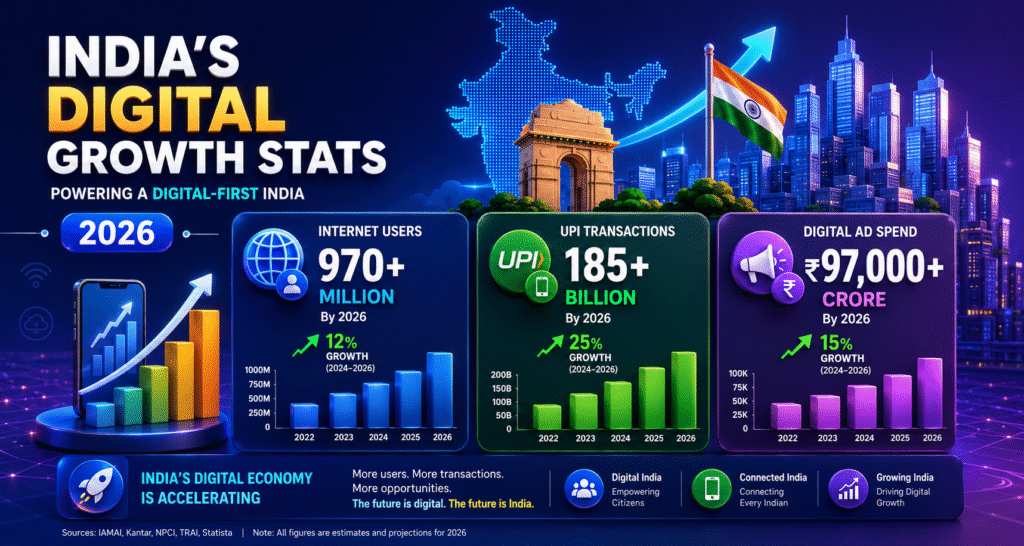
India now has over 900 million internet users, making it the world’s second-largest online market. Yet most businesses are still playing catch-up when it comes to leveraging the latest digital marketing trends in India. The landscape is shifting fast, fuelled by affordable data, a mobile-first population, and rapid AI adoption. Whether you run a D2C startup, a digital agency, or a traditional business trying to go online, understanding what’s coming in 2026 can mean the difference between leading your category and losing to a competitor who got there first. This guide breaks down the 10 most important Indian digital marketing trends you need to act on right now.
Why 2026 Is a Defining Year for Digital Marketing in India
The JIO revolution did not just give India cheap data; it rewired consumer behaviour completely. Today, UPI processes over 14 billion transactions per month, e-commerce is penetrating Tier 2 and Tier 3 cities at an unprecedented pace, and AI tools are being adopted by marketers faster than any technology in the last decade. According to a KPMG India report, the Indian digital advertising market is expected to cross INR 55,000 crore by 2026. Add to this the vernacular content boom and the meteoric rise of short-form video, and you have a market that demands smarter, faster, and more personalised strategies. This is why 2026 is not just another year for emerging trends in digital marketing in India; it is a turning point.
Trend 1: AI-Powered Marketing Automation
What It Is
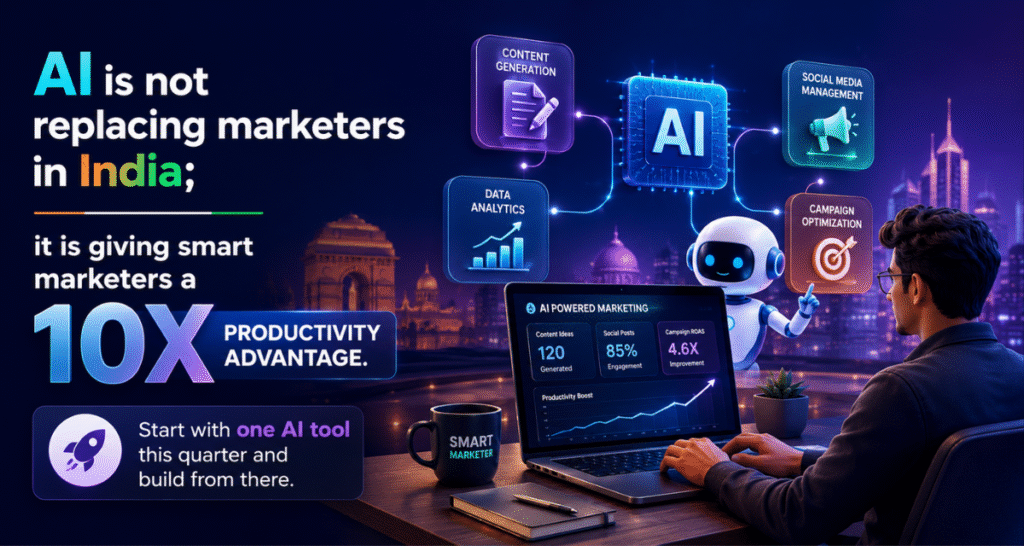
AI-powered marketing automation refers to using artificial intelligence to plan, execute, and optimise marketing tasks that would otherwise require significant manual effort. Tools like ChatGPT, Jasper, and Google’s Performance AI handle everything from content generation and audience segmentation to predictive bidding and personalised email journeys.
Why It Matters for Indian Brands
India’s sheer market diversity makes manual personalisation almost impossible. A brand selling across 28 states with 22 official languages cannot craft individual campaigns without automation. AI in digital marketing India solves this by enabling hyper-local targeting at scale. Brands like Nykaa and Meesho already use AI-driven recommendation engines that account for regional preferences, seasonal triggers, and browsing behaviour.
How to Use It in 2026
- Integrate AI writing assistants into your content workflow to produce localised blog posts, ad copy, and social captions faster.
- Use AI-powered CRM tools (like Zoho CRM AI or HubSpot’s AI features) to score leads and trigger contextual email sequences.
- Implement smart bidding in Google Ads and Meta Advantage+ campaigns to let AI optimise ad delivery based on real-time signals.
- Use AI chatbots on your website and WhatsApp to handle customer queries, qualify leads, and personalise product recommendations 24/7.
Trend 2: Regional Language & Vernacular Content SEO
What It Is
Vernacular content SEO is the practice of creating and optimising digital content in India’s regional languages, including Hindi, Tamil, Telugu, Kannada, Bengali, Marathi, and Gujarati, to capture organic search traffic from non-English-speaking audiences.
Why It Matters for Indian Brands
According to Google India research, over 70% of internet users in India prefer consuming content in their regional language. Hindi alone accounts for nearly 530 million speakers online. Despite this, most Indian business websites still publish content exclusively in English. This is a massive untapped SEO opportunity. Brands like Sharechat and Moj built multi-hundred-million-user bases by going vernacular first. Regional language SEO is one of the fastest-growing emerging trends in digital marketing in India, and the competition in these languages is still relatively low.
How to Use It in 2026
- Conduct keyword research specifically in regional languages using tools like Google Keyword Planner set to Hindi or Tamil.
- Translate and localise your top-performing English blog posts into 2-3 regional languages relevant to your target market.
- Optimise your Google Business Profile with regional language content to capture local search queries.
- Create dedicated landing pages in vernacular languages for product categories with high regional demand.
Trend 3: Short-Form Video Marketing (Reels & YouTube Shorts)
What It Is
Short-form video marketing involves creating engaging video content between 15 and 90 seconds for platforms like Instagram Reels, YouTube Shorts, and Moj. These formats prioritise entertainment, relatability, and quick consumption over polished production.
Why It Matters for Indian Brands
India has over 500 million Instagram users and 462 million YouTube users, and the vast majority consume video primarily on mobile. Reels get 22% more engagement than standard video posts on Instagram. Brands like Mamaearth and boAt built powerful brand identities on the back of consistent short-form video content. For smaller brands and local businesses, short-form video marketing is the most cost-effective awareness channel available today.
How to Use It in 2026
- Commit to a consistent posting cadence of at least 4 Reels per week; algorithm favour consistency over virality.
- Create “before and after,” tutorial, and behind-the-scenes formats that perform consistently well in the Indian market.
- Add regional language audio and text overlays to extend reach to non-English audiences.
- Repurpose the same core video across Reels, YouTube Shorts, and Moj to maximise reach from a single production.
Trend 4: Voice Search Optimisation
What It Is
Voice search optimisation is the process of tailoring your digital content so it appears in results for spoken queries made through Google Assistant, Siri, Alexa, or smart speakers. Voice queries are typically longer, more conversational, and question-based compared to typed searches.
Why It Matters for Indian Brands
India is among the top three countries globally for voice search usage. A significant driver is that many users find it easier and faster to speak than to type on a small smartphone screen, especially in regional languages. Queries like “Ok Google, sabse sasta smartphone kahan milega” are becoming mainstream. Smart brands are now building FAQ pages and structured content specifically designed to answer these spoken questions and capture featured snippet positions.
How to Use It in 2026
- Target long-tail, question-based keywords (who, what, where, when, how) in your blog content.
- Structure content with clear Q&A sections and use FAQ schema markup to compete for featured snippets.
- Optimise for local voice searches by maintaining a fully updated Google Business Profile.
Include natural language phrases in Hindi and other regional languages in your on-page content.
Trend 5: Hyper-Personalisation & First-Party Data Strategy
What It Is
Hyper-personalisation uses real-time data, AI, and behavioural analytics to deliver individually tailored content, product recommendations, and marketing messages to each customer. First-party data refers to information collected directly from your own customers through website interactions, purchases, and CRM tools.
Why It Matters for Indian Brands
With third-party cookies being phased out globally, brands that relied on retargeting via third-party data are scrambling. First-party data strategies are now a competitive necessity, not a nice-to-have. Indian e-commerce brands like Myntra and Flipkart have mastered this by building recommendation engines that feel eerily accurate. For smaller brands, even simple personalisation, such as addressing customers by name in WhatsApp messages or tailoring email content by purchase history, delivers significant lift in conversion rates.
How to Use It in 2026
- Build a robust email list and segment audiences by purchase behaviour, geography, and browsing history.
- Implement a Customer Data Platform (CDP) to unify data from your website, app, CRM, and social channels.
- Use personalised WhatsApp broadcast messages to send relevant offers based on past purchases.
- Offer value exchanges (discount codes, gated content) to encourage customers to share first-party data willingly.
Trend 6: Influencer & Creator Marketing 2.0 (Micro & Nano)
What It Is
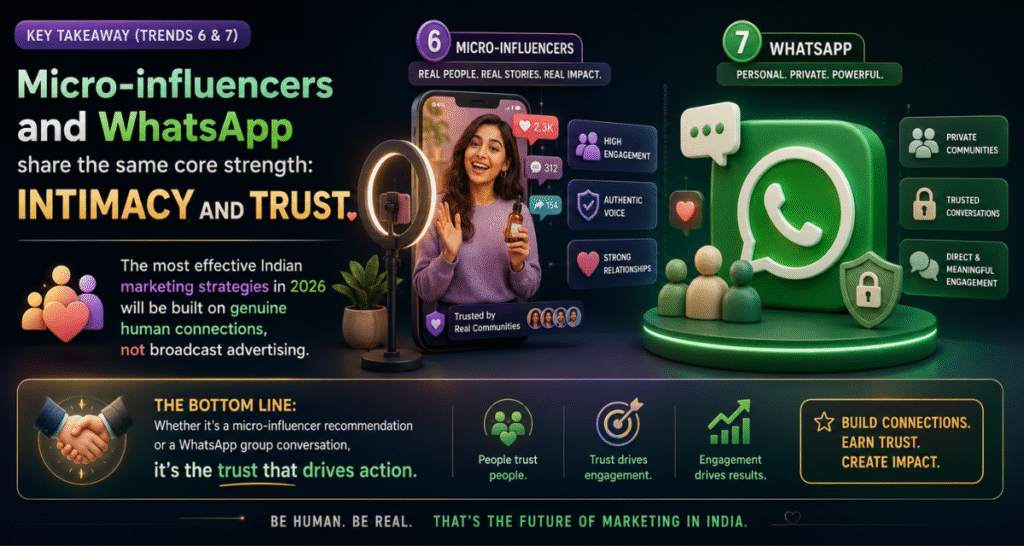
Influencer marketing 2.0 moves beyond big celebrities and focuses on micro-influencers (10,000 to 100,000 followers) and nano-influencers (1,000 to 10,000 followers) who have highly engaged, trust-based communities in specific niches or geographies.
Why It Matters for Indian Brands
As per a Statista report, the influencer marketing industry in India is projected to reach USD 340 million by 2026. More importantly, micro-influencers in India deliver 60% higher engagement rates than macro-influencers at a fraction of the cost. In Tier 2 cities like Indore, Jaipur, and Coimbatore, a local nano-influencer with 8,000 engaged followers can drive more in-store footfall than a Bollywood celebrity campaign. The shift toward performance-based influencer deals, where payment is tied to results, makes this channel even more attractive for ROI-focused marketers.
How to Use It in 2026
- Use platforms like Plixxo, OPA, or Winkl to discover and vet Indian micro-influencers by niche and location.
- Structure deals with performance KPIs, such as affiliate codes or UTM links, to track actual sales generated.
- Prioritise long-term creator partnerships over one-off posts for sustained brand recall.
Let creators produce content in their own voice; heavy-handed scripting reduces authenticity and kills engagement.
Trend 7: WhatsApp & Conversational Commerce
What It Is
Conversational commerce is the use of messaging apps, particularly WhatsApp in India, to facilitate the entire customer journey, from product discovery and queries to payment and post-purchase support, within a chat interface.
Why It Matters for Indian Brands
India has over 535 million WhatsApp users, making it the world’s largest WhatsApp market. WhatsApp marketing India is no longer experimental; it is a core channel for brands across sectors. D2C brands like The Whole Truth Foods and Wakefit use WhatsApp Business API to send order confirmations, handle returns, and push personalised product recommendations. Open rates for WhatsApp messages in India regularly exceed 90%, compared to around 20% for email. In-app checkout via WhatsApp Pay is making the path from conversation to conversion frictionless.
How to Use It in 2026
- Set up the WhatsApp Business API through verified BSPs (Business Solution Providers) like Interakt, Wati, or AiSensy.
- Build automated flows for cart abandonment, order tracking, and post-purchase follow-ups.
- Use Click-to-WhatsApp ads on Facebook and Instagram to drive conversations directly from your paid campaigns.
Create a WhatsApp catalogue to let customers browse and purchase products without leaving the chat.
Trend 8: Performance Max Campaigns & Smart Bidding
What It Is
Performance Max (PMax) is Google’s AI-driven campaign type that automatically serves ads across all of Google’s channels, including Search, Display, YouTube, Gmail, Maps, and Discover, from a single campaign setup. Smart bidding uses machine learning to set bids dynamically based on the likelihood of conversion.
Why It Matters for Indian Brands
Indian festive seasons, particularly Navratri, Diwali, and End of Season Sales, compress enormous purchase intent into short windows. Performance marketing teams that manually manage campaigns during these peaks inevitably leave money on the table. PMax campaigns with strong asset groups, audience signals, and conversion data are tailor-made for these high-velocity periods. Brands that adopted PMax early in India report 15-20% lower cost per acquisition compared to traditional search campaigns, according to Google India case studies.
How to Use It in 2026
- Feed PMax campaigns rich asset groups: at least 5 headlines, 5 descriptions, 5 images, and 1 video per campaign.
- Upload strong audience signals (your customer match list, website visitors) to help the AI learn faster.
- Run separate PMax campaigns for different product categories to maintain creative relevance.
- Monitor search term insights and add negative keywords at the account level to prevent wasted spend.
Trend 9: Programmatic & CTV/OTT Advertising
What It Is
Programmatic advertising automates the buying and placement of digital ads using algorithms and real-time bidding. Connected TV (CTV) and OTT advertising refers to serving ads on streaming platforms like JioCinema, Disney+ Hotstar, Sony LIV, and Zee5 that users watch on smart TVs, laptops, and mobile devices.
Why It Matters for Indian Brands
India’s OTT market crossed 500 million users in 2025, driven by affordable smart TVs and low-cost data. JioCinema’s free streaming of IPL matches attracted over 32 million concurrent viewers at peak, making it one of the most-watched sporting events in streaming history. This audience is now accessible through programmatic ad buying at relatively low CPMs compared to traditional television. Indian marketers who understand how to run CTV campaigns will access a premium, brand-safe inventory that their competitors are largely ignoring.
How to Use It in 2026
- Partner with programmatic DSPs like DV360, The Trade Desk, or India-specific platforms like Ditto TV and InMobi to access OTT inventory.
- Create 15-second and 30-second non-skippable video ads optimised for second-screen viewing on mobile.
- Use contextual targeting to place CTV ads alongside relevant content genres (sports, news, entertainment).
- Measure brand lift studies alongside direct response metrics to capture the full impact of CTV campaigns.
Trend 10: Purpose-Driven & Sustainability Marketing
What It Is
Purpose-driven marketing aligns brand messaging and actions with a larger social, environmental, or cultural cause. Sustainability marketing specifically communicates a brand’s environmental responsibility through its products, packaging, supply chain, or operations.
Why It Matters for Indian Brands
India’s Gen Z population, which makes up nearly 27% of the country, actively favours brands that stand for something beyond profit. A Nielsen India survey found that 73% of Indian millennials are willing to pay a premium for sustainable products. Brands like Fabindia, Paper Boat, and Amul have always built identity around cultural purpose, and a new wave of startups including Bare Anatomy and The Better India are making sustainability central to their brand stories. This is no longer just a Western trend; it is becoming a dominant force in Indian digital marketing trends.
How to Use It in 2026
- Identify one authentic purpose or cause that aligns naturally with your brand values, not something adopted just for PR.
- Create a dedicated content series (blog, Reels, YouTube Shorts) that documents your brand’s sustainability journey transparently.
- Partner with NGOs or local community initiatives and give audiences a direct way to participate (donate, volunteer, share).
- Use purpose-driven messaging in your festive campaign creatives to stand out in a cluttered advertising environment.
How to Prepare Your Brand for These Indian Digital Marketing Trends
- Audit your current digital presence: Identify which channels are driving real ROI today and which are costing you without results. Use Google Analytics 4, Meta Business Suite, and your CRM to get an honest picture.
- Pick 2-3 trends to focus on first: You cannot implement everything at once. Based on your industry, budget, and audience, select the 2-3 trends most likely to move the needle for your specific business.
- Invest in training or hiring for AI literacy: Every marketing team in India needs at least one person who understands how to use AI tools for content, ads, and data analysis. Upskill or hire in Q1 of 2026.
- Build your first-party data infrastructure now: Whether it is growing your WhatsApp subscriber list, your email list, or improving your CRM hygiene, start building the data assets that will drive personalisation.
- Set quarterly review cycles for trend adoption: Digital marketing evolves fast. Schedule a quarterly review to assess which emerging trends in digital marketing in India are gaining traction in your sector and adjust your strategy accordingly.