

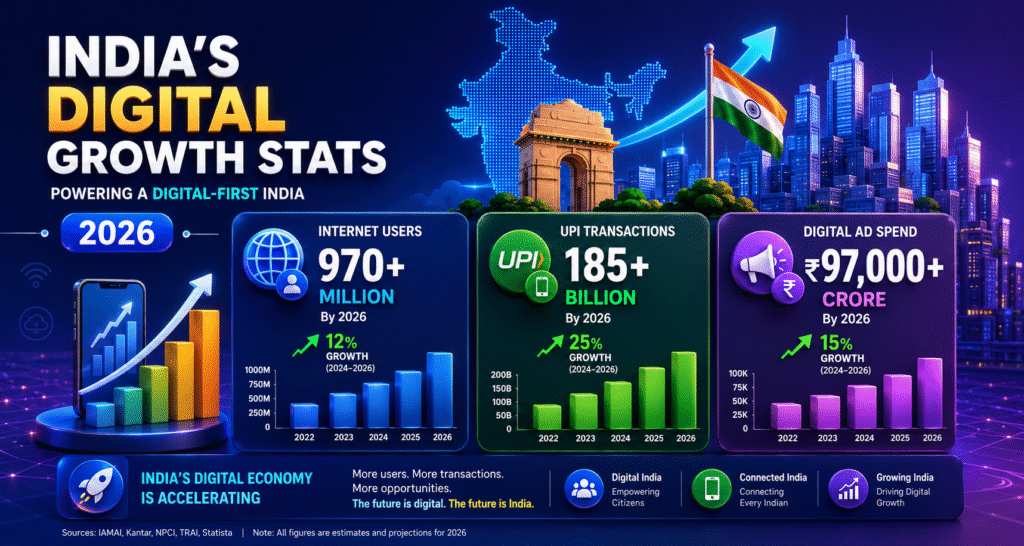
10 Digital Marketing Trends in India 2026 Every Marketer Must Know
India now has over 900 million internet users, making it the world’s second-largest online market. Yet most businesses are still playing catch-up when it comes to leveraging the latest digital marketing trends in India. The landscape is shifting fast, fuelled by affordable data, a mobile-first population, and rapid AI adoption. Whether you run a D2C startup, a digital agency, or a traditional business trying to go online, understanding what’s coming in 2026 can mean the difference between leading your category and losing to a competitor who got there first. This guide breaks down the 10 most important Indian digital marketing trends you need to act on right now. Why 2026 Is a Defining Year for Digital Marketing in India The JIO revolution did not just give India cheap data; it rewired consumer behaviour completely. Today, UPI processes over 14 billion transactions per month, e-commerce is penetrating Tier 2 and Tier 3 cities at an unprecedented pace, and AI tools are being adopted by marketers faster than any technology in the last decade. According to a KPMG India report, the Indian digital advertising market is expected to cross INR 55,000 crore by 2026. Add to this the vernacular content boom and the meteoric rise of short-form video, and you have a market that demands smarter, faster, and more personalised strategies. This is why 2026 is not just another year for emerging trends in digital marketing in India; it is a turning point. Trend 1: AI-Powered Marketing Automation What It Is AI-powered marketing automation refers to using artificial intelligence to plan, execute, and optimise marketing tasks that would otherwise require significant manual effort. Tools like ChatGPT, Jasper, and Google’s Performance AI handle everything from content generation and audience segmentation to predictive bidding and personalised email journeys. Why It Matters for Indian Brands India’s sheer market diversity makes manual personalisation almost impossible. A brand selling across 28 states with 22 official languages cannot craft individual campaigns without automation. AI in digital marketing India solves this by enabling hyper-local targeting at scale. Brands like Nykaa and Meesho already use AI-driven recommendation engines that account for regional preferences, seasonal triggers, and browsing behaviour. How to Use It in 2026 Integrate AI writing assistants into your content workflow to produce localised blog posts, ad copy, and social captions faster. Use AI-powered CRM tools (like Zoho CRM AI or HubSpot’s AI features) to score leads and trigger contextual email sequences. Implement smart bidding in Google Ads and Meta Advantage+ campaigns to let AI optimise ad delivery based on real-time signals. Use AI chatbots on your website and WhatsApp to handle customer queries, qualify leads, and personalise product recommendations 24/7. Trend 2: Regional Language & Vernacular Content SEO What It Is Vernacular content SEO is the practice of creating and optimising digital content in India’s regional languages, including Hindi, Tamil, Telugu, Kannada, Bengali, Marathi, and Gujarati, to capture organic search traffic from non-English-speaking audiences. Why It Matters for Indian Brands According to Google India research, over 70% of internet users in India prefer consuming content in their regional language. Hindi alone accounts for nearly 530 million speakers online. Despite this, most Indian business websites still publish content exclusively in English. This is a massive untapped SEO opportunity. Brands like Sharechat and Moj built multi-hundred-million-user bases by going vernacular first. Regional language SEO is one of the fastest-growing emerging trends in digital marketing in India, and the competition in these languages is still relatively low. How to Use It in 2026 Conduct keyword research specifically in regional languages using tools like Google Keyword Planner set to Hindi or Tamil. Translate and localise your top-performing English blog posts into 2-3 regional languages relevant to your target market. Optimise your Google Business Profile with regional language content to capture local search queries. Create dedicated landing pages in vernacular languages for product categories with high regional demand. Trend 3: Short-Form Video Marketing (Reels & YouTube Shorts) What It Is Short-form video marketing involves creating engaging video content between 15 and 90 seconds for platforms like Instagram Reels, YouTube Shorts, and Moj. These formats prioritise entertainment, relatability, and quick consumption over polished production. Why It Matters for Indian Brands India has over 500 million Instagram users and 462 million YouTube users, and the vast majority consume video primarily on mobile. Reels get 22% more engagement than standard video posts on Instagram. Brands like Mamaearth and boAt built powerful brand identities on the back of consistent short-form video content. For smaller brands and local businesses, short-form video marketing is the most cost-effective awareness channel available today. How to Use It in 2026 Commit to a consistent posting cadence of at least 4 Reels per week; algorithm favour consistency over virality. Create “before and after,” tutorial, and behind-the-scenes formats that perform consistently well in the Indian market. Add regional language audio and text overlays to extend reach to non-English audiences. Repurpose the same core video across Reels, YouTube Shorts, and Moj to maximise reach from a single production. Trend 4: Voice Search Optimisation What It Is Voice search optimisation is the process of tailoring your digital content so it appears in results for spoken queries made through Google Assistant, Siri, Alexa, or smart speakers. Voice queries are typically longer, more conversational, and question-based compared to typed searches. Why It Matters for Indian Brands India is among the top three countries globally for voice search usage. A significant driver is that many users find it easier and faster to speak than to type on a small smartphone screen, especially in regional languages. Queries like “Ok Google, sabse sasta smartphone kahan milega” are becoming mainstream. Smart brands are now building FAQ pages and structured content specifically designed to answer these spoken questions and capture featured snippet positions. How to Use It in 2026 Target long-tail, question-based keywords (who, what, where, when, how) in your blog content. Structure content with clear Q&A sections and use FAQ schema markup to compete for featured snippets. Optimise for local voice
10 Digital Marketing Trends in India 2026 Every Marketer Must Know Read More »